
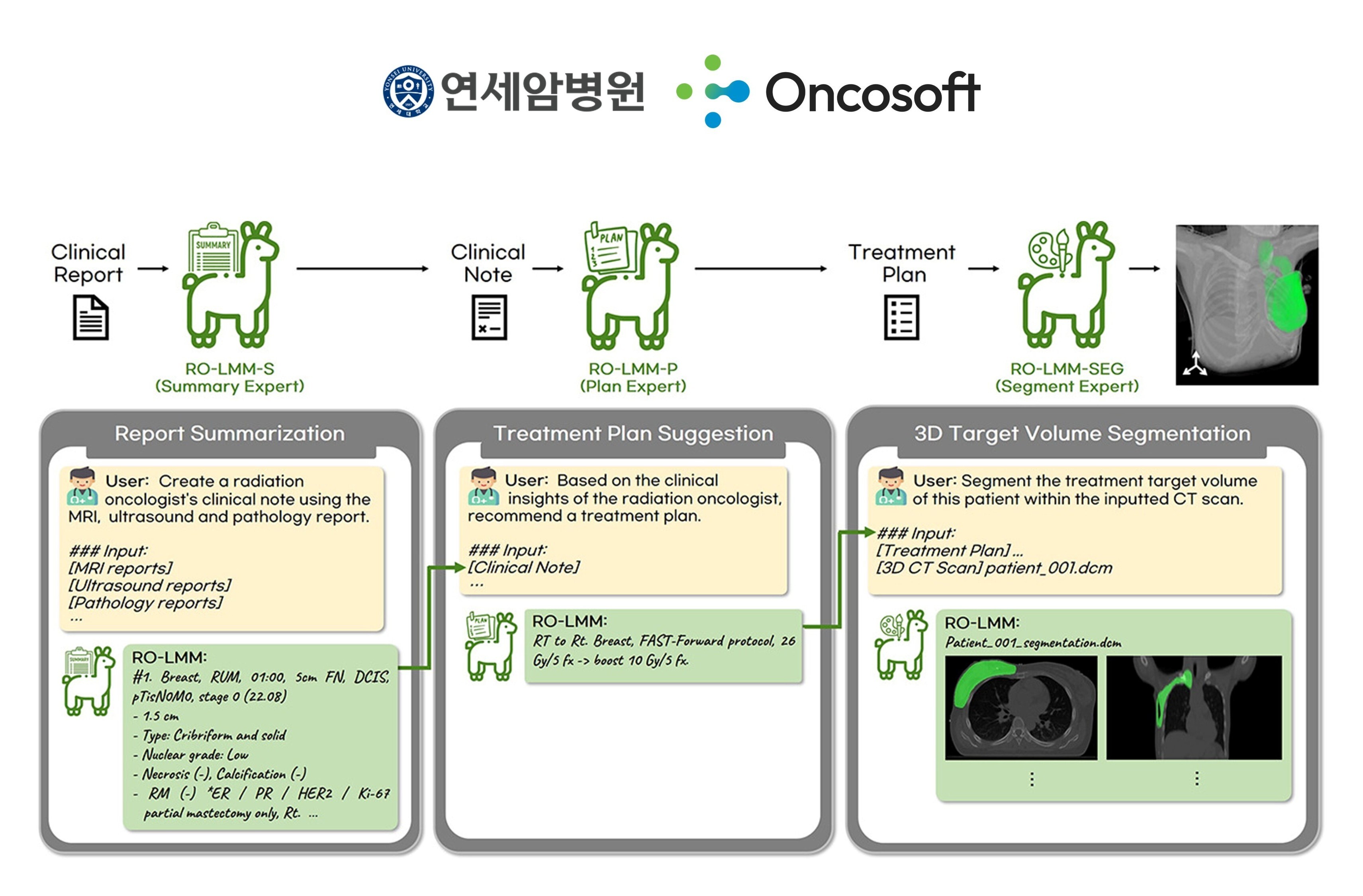
Oncosoft announced on the 4th that it has developed RO-LMM (Radiation Oncology-Large Multimodal Model), a large-scale multimodal AI model capable of automating the entire clinical process of radiation oncology.
This research was conducted in collaboration with Professors Sang-jun Park and Yong-bae Kim from the Department of Radiation Oncology at Yonsei University College of Medicine, and Professor Jong Chul Ye from the Kim Jaechul Graduate School of AI at KAIST. The study was published in Medical Image Analysis (IF 11.8), the most prestigious journal in the field of medical imaging.
RO-LMM is the world's first integrated framework where a single AI continuously performs three core stages of radiation therapy: clinical report summarization, radiation therapy strategy suggestion, and 3D target volume segmentation. Moving beyond the limitations of existing AI, which were confined to single functions like image segmentation, RO-LMM realizes the concept of 'Agentic AI' in the medical field by comprehensively analyzing various clinical data to suggest personalized treatment plans for each patient.
In this study, the research team introduced self-developed consistency-based learning techniques—‘Consistency Embedding Fine-Tuning (CEFTune)’ and ‘Consistency Embedding Segmentation (CESEG)’—to solve the problem of error accumulation that can occur in AI models processing multiple steps sequentially. These techniques allow the AI to derive stable and accurate results even in the presence of input errors or noise.
The research team trained the model using large-scale patient data collected from Yonsei Cancer Center and conducted external validation at Yongin Severance Hospital. The validation results showed that RO-LMM outperformed existing ChatGPT models by 21% in ‘clinical report summarization’ and recorded a score 68% higher than the state-of-the-art GPT-4 model in ‘treatment strategy suggestion.’
In the final stage of treatment planning, ‘3D target segmentation,’ accuracy improved by up to 10% compared to existing models. Specifically, for high-difficulty cases such as patients who underwent a total mastectomy, accuracy increased by up to 22.1%, proving greater clinical utility in complex scenarios. Furthermore, RO-LMM can process the entire workflow in approximately 10 seconds within a single GPU environment, demonstrating its practicality for real-world medical settings.
Oncosoft plans to go a step further by embodying RO-LMM’s technology as a ‘Conversational AI Agent’ and integrating it into its existing commercial software, 'OncoStudio.' This service, set to debut at the American Society for Radiation Oncology (ASTRO) meeting this September, aims to allow medical staff to complete treatment plans by communicating directly with the AI.
According to the company, through the AI agent, medical professionals can issue complex, multi-step commands—such as creating new treatment areas or automatically adjusting them based on anatomical standards—via chat or voice. In particular, the multimodal capability, which understands both CT images and various clinical records, enables the AI to make more precise judgments and execute tasks within the context of the entire patient dataset. The company expects OncoStudio to become a true intelligent clinical partner that accurately grasps and executes the intentions of medical staff by utilizing all its AI models and editing functions as a 'tool-set.'
Jin-sung Kim, CEO of Oncosoft, stated, "Based on these research results, we will move beyond simple automation to implement a true 'AI Attending Physician' that assists medical staff in decision-making, setting a new standard for radiation therapy. While challenges such as regulatory issues and integration with each hospital’s clinical information systems remain, we will do our best to ensure that Oncosoft’s AI technology ultimately contributes to providing optimal personalized precision medicine for all cancer patients."
